Showing posts with label Introduction to Electronics. Show all posts

February 07, 2011

Simple Basic Electronics (part 4)

(Elektronika Dasar)


Electrical Circuit

          An electrical circuit is any arrangement that permits an electrical current to flow. A circuit can be as simple as a battery connected to a lamp or as complicated as a digital computer.


A Basic Circuit


This basic circuit consists of a source of electrical current (a battery), a lamp and two connection wires. The part of a circuit which performs work is called the load. Here the load is lamp. In other circuits the load can be a motor, a heating element, an electromagnet, etc.


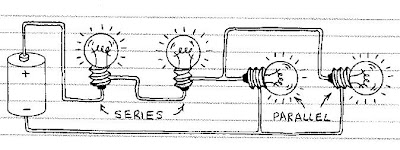
A Series Circuit


A circuit may include more then one component (switch, lamp, motor, etc). A series circuit is formed when current flowing through one component first flows through another. (Arrows show direction of electron flow)


A Parallel Circuit


A parallel circuit is formed when two or more components are connected so current can flow through one component without having first to flow through another.


A Series-Parallel Circuit


Many electrical circuits are both series and parallel. All provide a complete path between the circuit and its power supply.


Circuit Diagrams
Thus far the electrical circuits shown have been illustrated in pictorial form. In a circuit diagram pictorial views of component are replaced by component symbol.


Electrical "Short" Circuit
When a wire or other conductor is placed across the connection of a component, some or all of any current in the circuit may take a shortcut through the conductor. "Short" circuit such as this are usually undesirable at best. They can cause batteries to rapidly lose their capacity. And they can cause damage to wiring and components. "Short" circuit can even cause enough heat to ignite the insulation on a wire! Caution: the human body conducts electricity. Therefore carelessly touching an electrical circuit may cause a "short" circuit. If the voltage and current are high enough, you may receive a dangerous  or even lethal shock.


Electrical "Ground"
One of the wires of the AC lines is connected to earth by a metal rod. Metal enclosures of electrically powered devices are connected to this ground wire. This prevents a shock hazard should a non-grounded wire make contact  with the metal enclosure. Without the ground connection, a person touching the device while standing on the ground or a wet floor might receive a dangerous shock. Ground also refers to the point in a circuit at zero voltage, whether or not it's connected to ground. For instance, the minus (-) side of the battery in the circuit below can be considered ground.


That was a bit about basic electronics. Wait for the discussion of other electronics in the next article :)

The End.


Read more..

February 05, 2011

Simple Basic Electronics (part 3)

(Elektronika Dasar)


Electrical Current

The conductor - insulator demonstration illustrates two other important points:

  1. An immobile static charge flows through a conductor as an electrical current. It then resumes its static state on the Electroscope foil leaves.
  2. Electrical current flows from a region of high charge or potential to a region of low potential.


The Magnetic Connection
A current flowing through a wire creates a magnetic field around the wire. You cannot see the field, but you can observe its effect. Orient a compass so it needle points to the north (N) mark. Place a copper wire over and parallel to the needle. Then connect a flashlight cell across the wire and the needle will move away from its north-south orientation. (Leave the wire connected for only an instant to prevent the cell from overheating!)


Measuring Current Electricity
The physical (or mechanical) motion of a magnetic compass needle in a magnetic field provides a convenient way to measure the quantity of current flowing in a wire. This is the basic of the moving coil current meter used in the analog multimeter. To provide high sensitivity, the wire is warped as a coil.


Direct Current Electricity
An electrical current can flow in either of two directions through a conductor. If it flow in only one direction, whether steadily  or in pulses, it's called direct current (DC). It's important to be able to specify the quantity and power of a direct current. Here are the key terms:

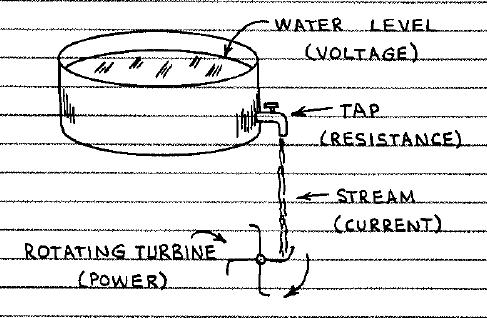
Current (I)
Current is the quantity of electrons passing a given point. The unit of current is the Ampere. One ampere is 6,280,000,000,000,000,000 (6.28 x 10^18) electrons passing a point in one second.

Voltage (V or E)
Voltage is electrical pressure or force. Voltage is sometimes referred to as potential. Voltage Drop is the difference in voltage between the two ends of a conductor through which current is flowing. If we compare current to water flowing through a pipe, then voltage is the water pressure.

Power (P)
The work performed by an electrical current is called power. The unit of power is the Watt. The power of a direct current is its voltage timesits current.

Resistance (R)
Conductor are not perfect. They resist to some degree the flow of current. The unit of resistance is the Ohm. A potential difference of one volt will force a current of one ampere through a resistance of one ohm. The resistance of a conductor is its voltage drop divided by the current flowing through the conductor.

Mr. Ohm's Law
Given any two of the above, you can find the other two using these formulas known as Ohm's Law:
V = I x R
I = V/R
R = V/I
P = V x I  or  I^2 x R


Summing Up: This is the "water analogy":


Alternating Current Electricity
A curent flowing through a conductor establishes a magnetic field around the conductor. This effect works both ways so that a current will flow in a field. You can easily demonstrate electromagnetic current generation with a coil of wire and a small magnet. Connect the leads of the coil to a meter designed to sense microampere. Insert a steel nail through the coil and stroke the magnet back and forth across the coil. The meter will indicate a few microampere each stroke.


When the magnet is stroked in one direction along the coil, electrons in the wire are moved in one direction and the direct current is produced. On away from the coil, the direction of current flow is reversed. Therefore, if the magnet is stroked back and forth along the coil, a current which alternates in direction or polarity is produced. It's called an alternating current (AC). Alternating current is ussually produced by rotating a coil in a magnetic field.


Sine Wave Measurement
AC voltage is usually specified at a value equal to the DC voltage capable of doing the same work. For a sine wave this value is 0.707 times the peak voltage. It's called the RMS (root-mean-square) voltage. The peak voltage (or current) is 1.41 times the RMS value. Household line voltage is specified according to its RMS value. Therefore, a household voltage of 120-volts corresponds to a peak voltage of 120 x 1.41 or 169.2-volts.


Why AC is used? AC is better suited than DC for transmission through long distance power lines. A wire carrying AC will induce a current in a nearby wire. This is the principle behind the Transformer.


to be continued..  Simple Basic Electronics (part 4)


Simple Basic Electronics (part 1)   Simple Basic Electronics (part 2)

Read more..

Simple Basic Electronics (part 2)

(Elektronika Dasar)


Static Electricity

          You generate static electricity every time you walk accross a carpet, pull tape from a roll, remove your clothing or dry clothes in a drier. Much of the time you don't even realize it unless the air is dry and the static charge suddently crackles, pops and flashes its way to a new home. These static charges are caused by mechanical friction. Back in 600 BC, thales of Greece experimented with the static electricity produced when amber is rubbed with wool.


Amber
Once upon a time sap flowing from trees hardened into clear golden nodules which were eventually buried in the earth. Sometimes, before it hardened into amber, the sticky sap entombed bits of plant metter, insects and even droplets of water. A kind of natural casting plastic, amber is easily electrified by friction. It then attratc bits of paper.


Electrified Plastic and Glass
Run a plastic comb through your hair on a dry day and you'll transfer electrons from your hair to the comb. Rub a glass rod with a silk or the synthetic fibers of a paint brush and you'll remove electrons from the class. Both the negatively charged comb and the positively charged glass rod will, like amber, attract bit of paper. You can electrify or charge many materials by rubbing them with fur, wool, etc. Metal? No, the charge leaks away.


Opposite and Like Charges
How do we know the cob and glass rod have opposite charges? A fundamental rule of electricity is like charge repel and unlike charges attract. Here's an experiment that proves the rule and answers the question.


Remember:
  • Unlike charges attract                            
  • Like charges repel


The Electroscope
The first instrument design to detect and measure static electricity was the electroscope. You can easily make one.


Be sure the folded foil strip is clean and dry. When you touch a charged object to the wire, the two halves of the foil strip will be given the same charge and will therefore fly appart.


Conductor and Insulator
You can use your electroscope to prove that electrons travel through some materials but not others. Hint: try this on a dry day! Electrons can travel through moist air so the charge on your electroscope will quickly leak away on humid day.


This demonstration shows that electrons can travel through some materials but not others. Materials through which electrons travel are conductors. Material through which electrons travel poorly or not at all are insulator.


Read more..

February 04, 2011

Simple Basic Electronics (part 1)

(Elektronika Dasar)


Electricity 

Back to Basics 

          Electricity is an essential ingredient of matter. The best way to understand the nature of electricity is to examine the smallest component of every element, the atom.


This is a Lithium atom.The third simplest atom after Hydrogen and Helium, Lithium atoms have 3 electrons that encircle a nucleus of 3 protons and 4 neutrons.
  • Electrons have a negative electrical charge.
  • Protons have a positive electrical charge.
  • Neutrons have no electrical charge.

Ions
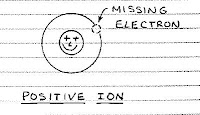
Normally an atom has an equal number of electrons and protons. The charges cancle to give the atom no net electrical charge. It's possible to dislodge one or more electrons from most atoms. This causes the atom to have a net positive charge. It's then called a positive ion. 


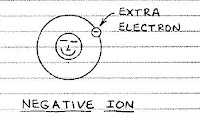
If a stray electron combines with a normal atom, the atom has a net negative charge and is called a negative ion.


Electrons
Free electrons can move at high speed through metals, gases and a vacuum, or they can rest on a surface.


More about free electrons
Many trillions of electrons can rest on a surface or travel through space or metter at near the speed of light (186,000 miles per second)


Resting Electrons
A group of negative electrons on a surface causes the surface to be negatively charged. Since the electrons are not moving, the surface can be said to have a negative static electrical charge.

Moving Electrons
A stream of moving electrons is called an electrical current. Resting electrons can quickly form an electrical current if placed near a cluster of positive ions. The positively charged ions will attract the electrons which will rush into fill the "holes" or void left by the missing electrons.


Missing Electrons
Mechanical friction, light, heat or a chemical reaction may remove electrons from a surface. This cause the surface to be positively charged. Since the positively charged atoms are at rest, the surface can be said to have a positive static electrical charged.


to be continued..  Simple Basic Electronics (part 2) 


Read more..